Tailscale vs WireGuard
When people switch to a new VPN setup, the frustration usually hits fast. Connections feel lightning quick on one device, sluggish on another, and suddenly a “secure tunnel” breaks the moment you leave home Wi-Fi. Some tools promise raw speed but demand constant babysitting, others feel effortless yet oddly opaque about what actually happens to your traffic. That gap between control and convenience is where many technically curious users stall, unsure whether performance problems are misconfiguration, network limits, or the tool itself.
This tension matters more today because VPN use has shifted from niche tinkering to everyday infrastructure. People rely on encrypted connections for remote work, personal servers, gaming sessions, and quick fixes on public networks. In that transition, users often choose tools for the wrong reasons, marketing claims, default settings, or fear of complexity. This is where WireGuard and Tailscale keep coming up in the same conversations, representing two very different responses to the same modern networking problems faced by individuals and small teams alike.
Reading further gives you something more useful than surface-level advice. You will see how control, automation, trust boundaries, and real-world reliability play out once theory meets daily use. The focus is on practical trade-offs, where each approach shines, where it quietly struggles, and what that means long term. By the end, the differences should feel grounded in experience, not abstractions or promotional language, especially for users balancing performance expectations with usability and long-term maintenance concerns in real networks under everyday conditions.
Table of Contents
Key Points
- WireGuard delivers excellent speed and efficiency thanks to a small code base and modern cryptography, making it ideal for users who want full control over their VPN setup.
- Tailscale removes most of the operational burden by automating key management, NAT traversal and device administration through a web interface and single sign-on.
- WireGuard is best suited for technically inclined users and administrators who value performance and customization, while Tailscale appeals to teams and individuals who prioritise simplicity, collaboration and features like MagicDNS and access control lists.
Core Concepts: Tailscale vs WireGuard
| Technology | Layer & scope | Typical use |
|---|---|---|
| WireGuard | VPN protocol operating at Layer 3 that combines key exchange and data encryption in a single, efficient protocol. | Point-to-point tunnels, self-hosted VPN servers, embedded systems, routers and many commercial VPN services. |
| Tailscale | Mesh overlay network built on WireGuard that adds a control plane for authentication, key distribution and device management. | Remote work setups, distributed teams, homelabs and zero-trust networking environments. |
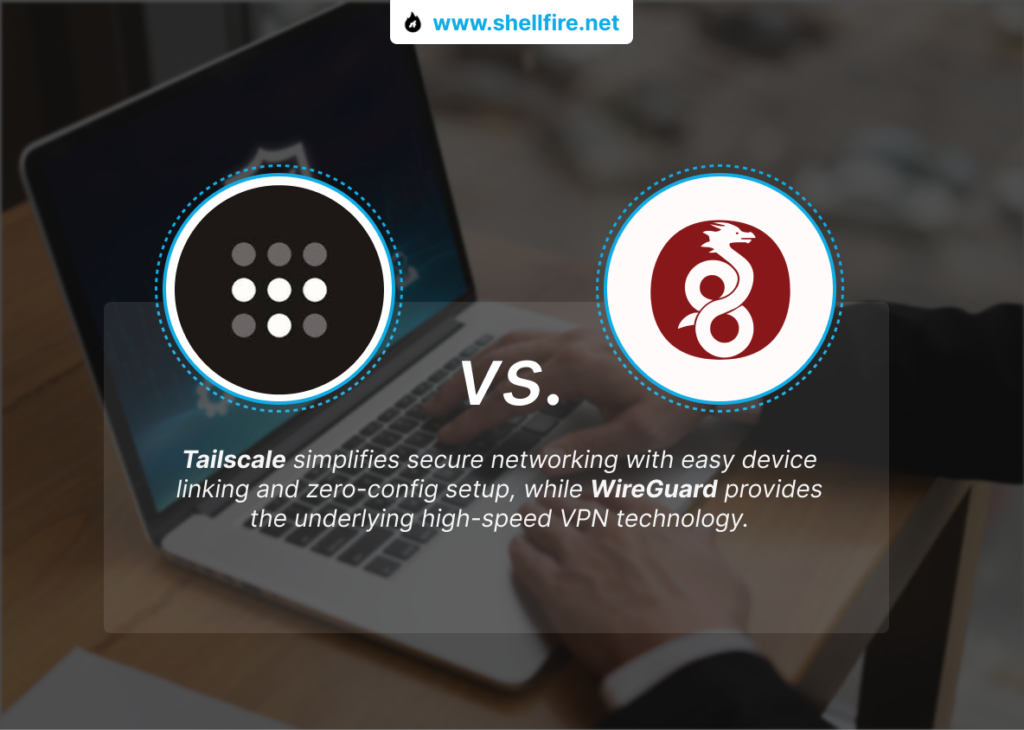
WireGuard can be compared to a high-performance engine. It delivers the raw capability to move encrypted traffic quickly and securely, but everything around it is left to the user. Tailscale takes that same engine and places it into a fully equipped vehicle with steering, safety systems and a dashboard. When you sign in using an identity provider such as Google, Microsoft or GitHub, Tailscale automatically enrols the device into your tailnet and distributes the necessary cryptographic keys behind the scenes. It also applies NAT traversal techniques and falls back to relay servers, known as DERP, to maintain connectivity even behind restrictive firewalls.
Without Tailscale, WireGuard users must exchange public keys manually and update configuration files on every peer whenever something changes. NAT traversal often requires port forwarding or static IP addresses, and there is no central access control system. Projects like Headscale or NetBird attempt to fill some of these gaps, but Tailscale currently offers the most polished and beginner-friendly experience.
Architecture & Security Model
| Aspect | WireGuard | Tailscale |
|---|---|---|
| Encryption & algorithms | Uses a fixed, modern cryptographic suite including Curve25519, ChaCha20, Poly1305 and BLAKE2. | Relies on WireGuard’s encryption and data plane, while enforcing access rules at the device level. |
| Key management | Keys are generated and distributed manually, and remain static unless rotated by an administrator. | Keys are distributed and rotated automatically through the coordination service, while private keys stay on each device. |
| NAT traversal | Requires manual configuration such as port forwarding or static addressing. | Handles NAT traversal automatically using STUN and falls back to DERP relays when direct connections fail. |
| Access control | No built-in access control lists, relying instead on firewall rules or external systems. | Centralised ACL policies defined in JSON, enforced locally by each device and integrated with identity providers. |
| Admin console | No native interface, configuration is done through text files or command-line tools. | Web-based admin console for managing devices, keys, ACLs and network settings. |
WireGuard’s security model is intentionally minimal. Each peer is identified by a public key and permitted IP ranges, and keys must be exchanged securely outside of the protocol. There is no concept of user accounts or roles, so access control must be implemented at a higher level. NAT traversal can be fragile, especially when network conditions change, unless additional tooling is used.
Tailscale preserves WireGuard’s cryptographic strengths while adding a dedicated control plane. Devices authenticate via single sign-on, receive short-lived keys and enforce access rules locally. MagicDNS allows devices to reach each other using readable hostnames, and access control lists limit which users can reach specific services. When peer-to-peer connections are not possible, DERP relay servers keep traffic flowing. Importantly, private keys never leave the device, and Tailscale cannot decrypt user traffic.
Performance & Overhead
| Metric | WireGuard | Tailscale |
|---|---|---|
| Throughput | Excellent throughput, especially on Linux where it runs in the kernel and can reach near line speed. | Very strong performance overall, with a small overhead due to coordination services and optional relay usage. |
| Latency | Very low latency thanks to direct peer-to-peer tunnels. | Slightly higher latency when traffic is routed through DERP relays, usually negligible in everyday use. |
| Resource usage | Extremely lightweight, with low CPU usage and minimal impact on battery life. | Low overhead, with a modest additional footprint from the management layer. |
| Reconnection & mobility | Reconnections often require manual intervention, and roaming between networks can break tunnels. | Handles roaming seamlessly, automatically reconnecting when networks change. |
WireGuard’s performance is one of its strongest selling points. On Linux servers and routers, it routinely delivers near line-speed throughput with minimal latency. Even on Windows and macOS, where user-space implementations are used, it typically outperforms older VPN protocols. The main limitation appears when peers cannot connect directly, as WireGuard offers no built-in relay mechanism.
Tailscale introduces a small performance overhead due to its coordination layer, but in practice this is rarely noticeable. On Linux systems it can also take advantage of the kernel module, and real-world speeds can reach multiple gigabits per second. When direct connections fail, traffic is routed through DERP relays, which increases latency slightly but prioritises reliability and continuity.
Privacy, Anonymity & Metadata
| Consideration | WireGuard | Tailscale |
|---|---|---|
| IP exposure | Public keys are mapped to IP addresses, with no built-in mechanism to conceal source IPs. | Similar exposure at the data plane level, while the control plane can see which devices belong to a tailnet. |
| Metadata visibility | Minimal metadata during handshakes, although administrators can observe connected peers. | The coordination service is aware of device relationships, and relay servers may see connection metadata. |
| Logging risk | Depends entirely on who operates the server and how logs are configured. | Private keys stay on devices, and traffic is encrypted end to end, but trust in the service provider is required. |
| Correlation & threat models | No anonymity features by design, peers are identified by persistent public keys. | Not designed for anonymity, device relationships can be correlated within the control plane. |
On its own, WireGuard does not aim to provide anonymity. Any server or peer can associate a public key with an IP address and connection history. This is not a flaw, but a design decision that prioritises simplicity and performance. As a result, WireGuard is best suited for trusted environments or scenarios where identity is not meant to be hidden.
Tailscale does not fundamentally change this model. It adds a coordination layer that introduces additional metadata, such as which devices belong to a given tailnet and how they are authenticated. The company does not have access to private keys and cannot decrypt traffic, but users still need to be comfortable with the idea of a third-party control plane. For users with higher anonymity requirements, neither solution is sufficient on its own, and additional layers such as Tor or multi-hop VPN routing would be necessary.
Compatibility & Ecosystem Support
| Factor | WireGuard | Tailscale |
|---|---|---|
| OS & device support | Available on Linux, Windows, macOS, iOS, Android and BSD, and widely supported by routers. | Clients for all major desktop and mobile platforms, with packages for NAS systems and firewalls. |
| Third-party tools & libraries | Extensive ecosystem and broad adoption across self-hosted and commercial VPN solutions. | Primarily a SaaS product with integrations for identity providers and developer platforms. |
| Self-hosting | Fully self-hosted by design, giving complete control over infrastructure and data. | Requires the hosted service by default, but can be self-hosted using the open-source Headscale backend. |
| Integration with VPN services | Widely used by consumer VPN providers as a transport protocol. | Functions as its own networking service rather than integrating with consumer VPN offerings. |
The open-source nature of WireGuard makes it extremely flexible. It is embedded in routers, NAS devices, cloud servers and even IoT systems. Many modern VPN platforms and mesh networking tools rely on WireGuard as their transport layer, which speaks to its reliability and long-term viability.
Tailscale focuses on polished cross-platform clients and tight integration with identity providers. It supports a wide range of operating systems and works well in mixed-device environments. For organisations that require full control over infrastructure, the Headscale project enables self-hosting of the coordination server, although the official Tailscale clients are still used.
Looking for reliable streaming access across all devices?
Our Shellfire Box is designed to provide consistent access to your favorite streaming platforms, which can be a helpful solution if you’re experiencing issues with other VPNs.
For users who prefer a consumer-friendly experience without managing servers or keys, the Shellfire Box provides preconfigured WireGuard tunnels, while the Shellfire VPN app automatically selects the most suitable protocol.
Ease of Use & Setup
| User aspect | WireGuard | Tailscale |
|---|---|---|
| Configuration for end users | Manual setup involving key generation, configuration files and IP assignment. | Simple login via single sign-on, with no manual configuration required. |
| Setup for admins | Requires ongoing management of keys, firewall rules and NAT traversal. | Centralised management through a web console with automated networking tasks. |
| Common mistakes | Incorrect allowed IP ranges, broken port forwarding and stale keys. | Overly permissive ACLs, confusion around MagicDNS and reliance on hosted infrastructure. |
Using WireGuard effectively requires a solid understanding of networking fundamentals. Administrators must plan IP addressing carefully, distribute keys securely and ensure firewall rules are correctly applied. While this provides flexibility, it also introduces more room for human error as networks scale.
Tailscale is designed to remove these friction points. Installation typically takes minutes, and devices appear in the admin console almost instantly. Administrators can define access rules centrally without touching configuration files. The trade-off is dependency on a managed service, although this can be partially mitigated by self-hosting the control plane.
Limitations & Risks
| Issue | WireGuard | Tailscale |
|---|---|---|
| Known weaknesses | Lacks built-in user management, ACLs and automated NAT traversal. | Relies on a central coordination service and a mostly closed-source control plane. |
| Misconfiguration risks | Overly broad IP permissions, outdated software and exposed services. | Incorrect ACL rules or misunderstandings of exit node behaviour. |
| Legal and policy risks | Self-hosted setups may conflict with organisational policies. | Use of third-party identity providers may expose metadata. |
| Misuse scenarios | Publicly exposed servers without proper firewall protection. | Overreliance on free tiers or misconfigured DNS pointing to insecure services. |
The main limitation of WireGuard is not security, but manageability. Without proper planning and tooling, even experienced administrators can make mistakes that expose internal services. Regular audits and key rotation are essential.
Tailscale addresses many of these issues but introduces new trade-offs. Dependence on a SaaS provider, potential vendor lock-in and trust in third-party infrastructure are all factors to consider. While the free tier is generous for personal use, larger teams will need a paid plan to avoid device and user limits.
Best Use Cases: When to Choose Tailscale or WireGuard
| Use case | WireGuard | Tailscale |
|---|---|---|
| Everyday browsing | ⭐⭐⭐⭐⭐ | ⭐⭐⭐⭐⭐ |
| Streaming | ⭐⭐⭐⭐⭐ | ⭐⭐⭐⭐ |
| Torrenting / P2P | ⭐⭐⭐⭐ | ⭐⭐⭐⭐ |
| Gaming | ⭐⭐⭐⭐⭐ | ⭐⭐⭐⭐ |
| Remote work | ⭐⭐⭐⭐ | ⭐⭐⭐⭐⭐ |
| High privacy / anonymity | ⭐⭐⭐ | ⭐⭐⭐ |
| Censorship-heavy countries | ⭐⭐⭐ | ⭐⭐⭐ |
Everyday Browsing & Streaming
For general browsing and media consumption, both WireGuard and Tailscale can feel fast and responsive. WireGuard’s minimal overhead is great for everyday tasks like loading news sites, watching YouTube, or hopping between apps on a phone. The “it just gets out of the way” experience is a big reason it is so widely adopted.
Tailscale can be just as smooth when devices connect directly. If a direct peer-to-peer connection is blocked by NAT or restrictive networks, it may route traffic via a DERP relay, which can introduce a small delay. In practice, most people will not notice this for typical browsing or video playback, but it can matter if you are trying to squeeze the last bit of performance from a home media server.
One practical difference is what you are trying to achieve. If you want to connect to your own devices or self-hosted services, Tailscale’s MagicDNS can make that experience friendlier, for example, “media-server” instead of remembering an IP address. If you are using a consumer VPN to access streaming libraries or reduce tracking across public Wi-Fi, WireGuard is often the underlying protocol used by many VPN providers, while Tailscale is primarily aimed at private networking between your own devices.
If you want a zero-config solution that automatically selects the best protocol and a suitable server for streaming and general use, the Shellfire Box or Shellfire VPN app can be a convenient option. It uses WireGuard or other protocols depending on what yields the best speed and helps with typical geo-restriction scenarios, without asking you to manage keys or routing rules.
Torrenting / P2P
Torrenting is a mix of speed, stability and network “plumbing”. WireGuard is excellent on performance, but you are responsible for NAT traversal and port forwarding if your setup requires it. In a home lab or a VPS scenario, that might be fine, especially if you already know your way around router rules and firewall policies.
Tailscale makes peer connectivity easier because it handles NAT traversal automatically and falls back to relays when needed. The trade-off is that relayed connections can reduce throughput on large transfers. For occasional P2P downloads, that might be acceptable. For heavy, daily torrenting, it is usually more efficient to run a self-hosted WireGuard server or choose a VPN provider that supports WireGuard plus features like port forwarding and stable exit IP behaviour.
It is also worth saying out loud: neither WireGuard nor Tailscale magically makes torrenting “anonymous”. They encrypt traffic, but your activity can still be linked to an exit IP somewhere. If privacy is a priority, a dedicated VPN provider with a strong no-logs approach and a proven track record is the better fit. Users who want that kind of turnkey privacy often prefer an app-based provider such as Shellfire VPN, rather than building and maintaining their own infrastructure.
Gaming & Latency-Sensitive Use
Gaming is where small latency differences can actually be felt, especially in fast competitive titles. WireGuard tends to win here because it is lightweight, direct, and often runs very efficiently on Linux. When the tunnel is peer-to-peer and you have a stable network path, it is hard to beat for raw responsiveness.
Tailscale can still be perfectly fine for casual play, co-op sessions, or connecting to a game server hosted at home. The main downside appears when traffic is forced through a DERP relay due to NAT limitations, which can add extra hops and raise ping. It is not always a deal breaker, but if you are the kind of person who already cares about bufferbloat and router QoS settings, you will probably prefer raw WireGuard for the cleanest path.
For competitive gaming or local network emulation (think small LAN-style sessions across the internet), raw WireGuard is usually the safer bet. If your goal is to protect the entire home network without configuring each individual device, the Shellfire Box can route all traffic through a WireGuard tunnel in a more plug-and-play way, which is handy if you have consoles, smart TVs or other devices that do not offer native VPN apps.
Remote Work & Business Use
Remote work often comes down to consistency and access control rather than maximum throughput. WireGuard gives you the building blocks, but you still need to manage key distribution, user offboarding, ACL logic (via firewalls) and routing. That is completely doable, but it can become a time sink once you have multiple teams, contractors, and rotating devices.
Tailscale shines in this area because it is designed around identity-based access. Single sign-on, device enrollment, and centrally managed ACLs make it easier to give the right people access to the right resources, and to revoke that access quickly when needed. Features like subnet routing and MagicDNS are also practical for hybrid setups, for example, reaching an internal NAS, a staging server, or a small on-prem service without exposing it to the public internet.
Businesses with strict compliance needs sometimes prefer to self-host the coordination layer using Headscale or use other platforms that layer enterprise controls on top of WireGuard. For smaller teams, though, Tailscale’s managed model is often “good enough”, and the time saved on administration is the real win.
High-Privacy & Anonymity Needs
This is the part where expectations matter. Neither WireGuard nor Tailscale is built as an anonymity tool. They encrypt data in transit, but they do not hide the fact that a device is connected, and they do not automatically prevent correlation by an exit network or service provider.
With raw WireGuard, your privacy depends heavily on who runs the server and what they log. With Tailscale, private keys remain on devices and traffic is end-to-end encrypted, but the control plane still knows about tailnet membership and device relationships. Self-hosting with Headscale reduces reliance on a third-party coordination service, but it does not suddenly turn it into an anonymity network.
If anonymity is truly the goal, users typically layer additional protections such as Tor, multi-hop VPN routing, or obfuscation, depending on the threat model. In that scenario, a commercial VPN that supports WireGuard plus obfuscation features can be more practical than trying to bolt anonymity onto a private mesh network. The Shellfire Box offers encrypted tunnels for home or travel use, but it is not designed to hide identity from an exit provider.
Use in Censorship-Heavy Countries
In heavily censored networks, the challenge is often not encryption, but getting a connection in the first place. WireGuard typically uses UDP and predictable patterns, which some firewalls can block or throttle. You can work around this with additional tooling, for example tunnelling over TCP or using obfuscation layers, but that adds complexity and can reduce performance.
Tailscale has a practical advantage here because it can fall back to DERP relays that operate over TCP port 443, which resembles ordinary HTTPS traffic. That does not guarantee success in every environment, but it can help in places where UDP is restricted or where direct peer-to-peer connectivity keeps failing. The trade-off is speed, because relayed paths can be slower than direct tunnels.
For consistently bypassing censorship, many users end up choosing a consumer VPN provider that actively invests in stealth modes and server rotation, rather than relying on raw WireGuard or a private mesh alone. The Shellfire VPN app, for example, offers stealth options intended to make VPN traffic look more like regular web traffic, which can be more effective than depending solely on default WireGuard or Tailscale behaviours.
Conclusion
WireGuard is best understood as the lightweight, high-performance engine behind many modern VPN solutions. Its small code base, strong cryptography and excellent speed make it a favourite among power users, homelab enthusiasts and administrators who want full control over their network stack. It does exactly what it promises, encrypt traffic efficiently, without adding unnecessary complexity. The trade-off is that you are responsible for everything else, from key management to NAT traversal and access control. For experienced users, that flexibility is a strength. For others, it can quickly become a maintenance burden.
Tailscale takes the same core technology and builds a complete networking experience around it. By adding identity-based authentication, automatic key rotation, NAT traversal and a central admin console, it turns WireGuard into something that feels almost invisible in daily use. Devices connect quickly, roam seamlessly between networks and can be managed without touching configuration files. This makes Tailscale particularly attractive for remote work, distributed teams and mixed-device environments. The compromise is a degree of dependence on a managed service and acceptance of a control plane that sits outside your own infrastructure.
Choosing between the two comes down to priorities. If maximum performance, fine-grained control and avoiding vendor lock-in matter most, raw WireGuard is hard to beat. If convenience, collaboration and minimal setup are more important, Tailscale is often the more practical choice. In some setups, the two can even complement each other, for example by running WireGuard for high-performance paths while using Tailscale or Headscale to simplify device management.
For users who prefer not to deal with protocols, keys or routing decisions at all, solutions like the Shellfire Box and the Shellfire VPN app are worth considering. They are not positioned as replacements for WireGuard or Tailscale in complex networking scenarios, but as streamlined alternatives that hide technical details while still delivering strong encryption and reliable connectivity. Depending on your needs, they can be a simpler and more predictable way to stay protected without building and maintaining your own VPN infrastructure.
If you are exploring how different VPN services build on protocols like WireGuard, you may also find our comparisons useful, such as ExpressVPN vs NordVPN or ExpressVPN vs Surfshark, which look at how commercial providers turn these underlying technologies into consumer-friendly products.